A Casualty--in the Psychiatric Ward
Morris Hirsch moved on to the European Casualty Department, (the equivalent of the current US Emergency Room.) Housemen (Interns) earned £5 a month, now he had moved up to £20 per month.
Morris Hirsch moved on to the European Casualty Department, (the equivalent of the current US Emergency Room.) Housemen (Interns) earned £5 a month, now he had moved up to £20 per month.
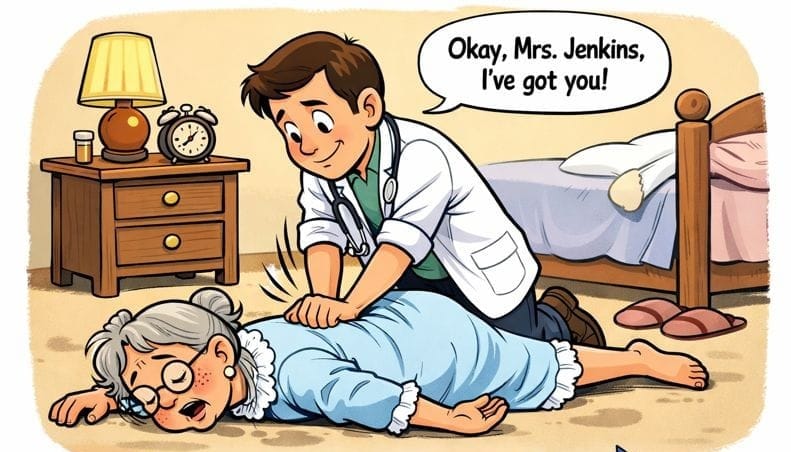
He spent three months there. Attached to Casualty was a psychiatric wing for cases awaiting accommodation in a mental institution. One day he heard a hullabaloo coming from the wing and a frantic call for help. A dishevelled woman in a nightgown lay unconscious on the floor with a porter kneeling above her head vigorously applying the old fashioned Schaffer's artificial respiration (mouth to mouth breathing was a much later post WWII advance.)
Morris instantly realized no air exchange was taking place, even when he elevated the chin to obviate tongue obstruction of the airway. She was cyanosed, her pulse thready and muscles limp: asphyxia was well advanced. A spatula look into the mouth and throat revealed a mass of material beyond the tongue. While the nurse rushed for a laryngoscope, he stuck two fingers in her throat and hooked out lumps of unchewed meat. With the laryngoscope, he cleared still more meat sitting on the larynx and blocking it. (Fortunately, the pieces were too large to be inhaled into the trachea.)
Once the airway was established, recovery was dramatic. Smiles and amazed approval all round!
So often during Morris' medical life he found the obvious simple vital first step in respiratory emergencies–to check and ensure an unobstructed airway–wasn't done! (Often, even in recent times, he noticed the rush to mouth to mouth breathing before attention to the airway.)
In cases of drowning, you rarely see the patient prone, with head to one side and the body jackknifed at the hips to run water out of the air passages as the first step; and when commencing mouth to mouth breathing, to leave the nose open to be able to blow water out.
Even in the operating theatre, in the absence of a trained anesthetist, he has witnessed disaster and near disaster because the inexperienced doctor or nurse has failed to establish a patent airway, rushing for the oxygen when there is no pathway to the lungs. Even the victim's heaving of the chest in vain attempts to get breath, so obviously diagnostic, sometimes fails to alert the would-be rescuers. Similarly, sitting up a person who has fainted, compromises even more the cerebral circulation essential to the vital functions.
It was the end of May 1940. Morris was impatient. Other doctors less eligible, like middle aged and married men, were being called up for their 30 day military training but he wasn't able to pull strings. The Casualty officer position was a dead end...

The historical novel Whitewashed Jacarandas and its sequel Full of Possibilities are both available on Amazon as paperbacks and eBooks.
These books are inspired by Diana's family's experiences in small town Southern Rhodesia after WWII.
Dr. Sunny Rubenstein and his Gentile wife, Mavourneen, along with various town characters lay bare the racial arrogance of the times, paternalistic idealism, Zionist fervor and anti-Semitism, the proper place of a wife, modernization versus hard-won ways of doing things, and treatment of endemic disease versus investment in public health. It's a roller coaster read.
References: Germiston Municipal Offices.
Excerpt from Dr. Morris Isaac Hirsch's Unpublished Memoirs. Hirsch Archives.