Back to the City
Morris Hirsch decided the platteland (countryside) was not for him.

Morris Hirsch decided the platteland (countryside) was not for him. Although there were no takers for the Tweespruit practice, after six weeks he was offered a rotating Eye/ENT houseman vacancy at the Johannesburg General Hospital–an entry to the teaching hospital at last! He was overjoyed to be back in the City of Gold, the golden mine dumps, people and bustle.
Houseman days were stimulating and fulfilling. He assumed the wide range of medical responsibilities. He made the decisions and had to live with them, with his own conscience and under the scrutiny of patient, nursing staff and the chiefs. The close contact with young nurses led inevitably to relationships and temptations that were exciting but could be complicating. Being in residence loosened the constraints of family dependence with a fresh sense of freedom. This was a watershed moment for him which was deeply satisfying.
The first stint was six weeks of internship in the Ophthalmology department, covering both the European and Non-European wards. The specialty at that time had limited scope. Visual testing, eye infections, trauma and glaucoma (high intraocular pressure) made up the mass of consulting while operating procedures were largely confined to enucleation (surgical removal of the eyeball), ocular tension drainage, cataract removal and corneal grafting–the latest advance. Intern operating was restricted to the first procedure, the remainder were the preserve of Chiefs.
There were two valid objections to allowing the intern to acquire the full range of expertise. These definitive procedures were hazardous. Patients were required to be nursed flat on their backs for ten days to improve the chance of success. Failures were disasters. Against the advances in instrumentation and techniques of today, the chancy efforts in 1939 were indeed primitive.
Secondly, these operations would not be part of a general practitioner's repertoire, so acquiring the skill was pointless. This training was reserved for incipient Ophthalmologists when specialization was inaugurated in South Africa. Enucleation could be an emergency in the pre-antibiotic days and was not inordinately hazardous: hence the intern was given the opportunity to learn and usually on the Non-European, non-paying, patient. Morris found enucleating an eye gruesome and avoided cases if he could.
Testing for visual correction and spectacles prescribing was also not part of their function, presumably because they would also not use it in general practice. In essence the houseman was the Chiefs' 'skivvy' - there to facilitate his routine.
The great value of the job however was learning to use an ophthalmoscope and visualizing the retina as diagnostic evidence of general disease.
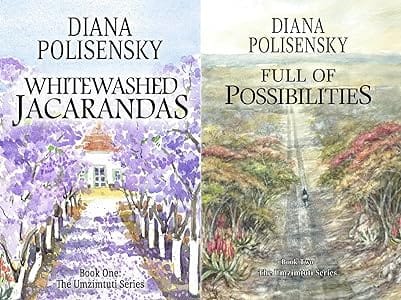
The historical novel Whitewashed Jacarandas and its sequel Full of Possibilities are both available on Amazon as paperbacks and eBooks.
These books are inspired by Diana's family's experiences in small town Southern Rhodesia after WWII.
Dr. Sunny Rubenstein and his Gentile wife, Mavourneen, along with various town characters lay bare the racial arrogance of the times, paternalistic idealism, Zionist fervor and anti-Semitism, the proper place of a wife, modernization versus hard-won ways of doing things, and treatment of endemic disease versus investment in public health. It's a roller coaster read.
References:
Excerpt from Morris Isaac Hirsch Memoirs, Hirsch Archives.
Phot Reference: The Heritage Portal
https://www.theheritageportal.co.za/article/what-was-johannesburg-1931