The Battle for Gondar
The stronghold at Wolchifit Pass had been besieged by irregular Ethiopian forces, led by Major B. J. Ringrose since May, 1941. The Italians unexpectedly surrendered to Brigadier W. A. L. James of the 25th East African Brigade on September 28, 1941.

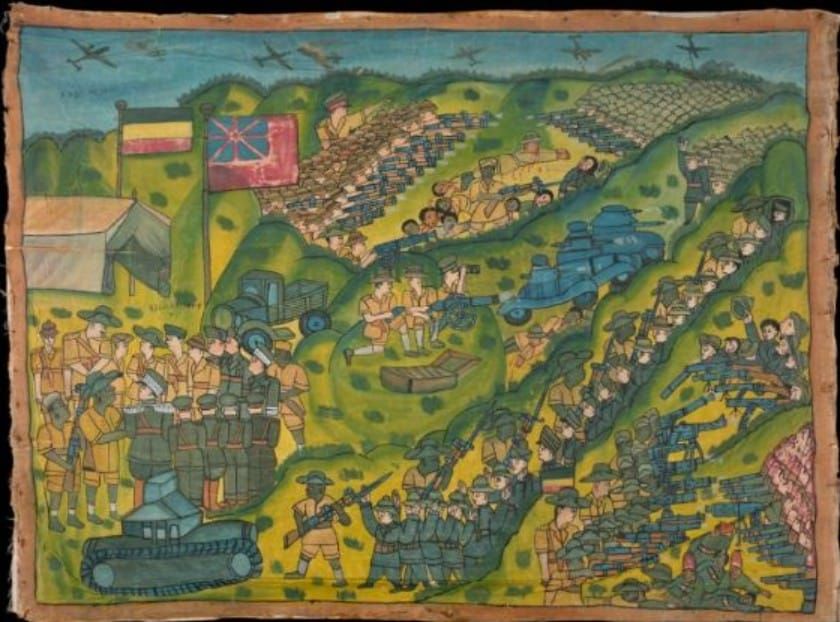
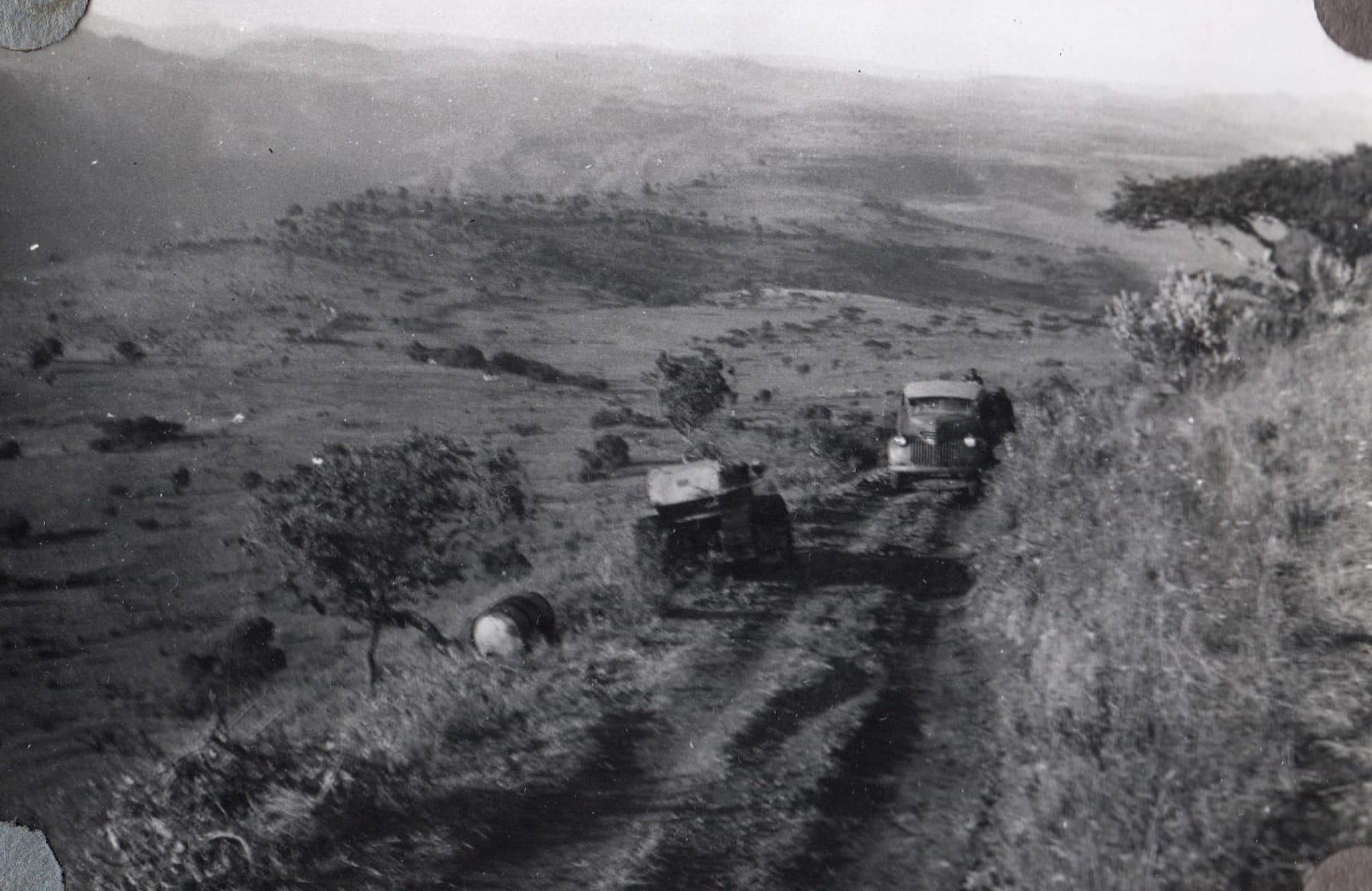
The way to Gondar, the last Italian fort, was now clear. But most of the British, South African and Indian troops had been sent to the crucial defense of Cairo. South African artillery and engineers and East and West African brigades and the Gordon Highlanders Regiment remained in the field in Northern Abyssinia. Fighting was not expected during the "Big Rains".
General Wavell instructed General Cunningham make the lines of communication more secure authorizing him to continue to act offensively until the end of May. The successful course of these operations caused this restriction to lapse in spite of the weather.
But, fighting thereafter was slow. Only late in November did the allies occupy Amba Giorgis, the last stronghold, 26 miles north of Gondar on the only paved road, which the Italians had evacuated on the 5th of May.
The Kulkabar Pass to the south-east was also taken, on the 21st November. Because of its very poor road, it was irrelevant to the Battle of Gondar.
The RAF, SAAF and artillery continued to support the troops, especially maintaining the morale of the Patriots (Arbegnoch) with drops of food and ammunition and silver 1780 Maria Teresa thalers minted in Bombay (not Austria!)
The Italian commander, General Nasi, had about 41,000 men and 70 guns at Gondar on his muster. But the garrison was seriously depleted, many Askari, mainly from Eritrea and Italian Somaliland, being unpaid, had deserted. The Italian national troops were losing heart too, but General Nasi was resolute.
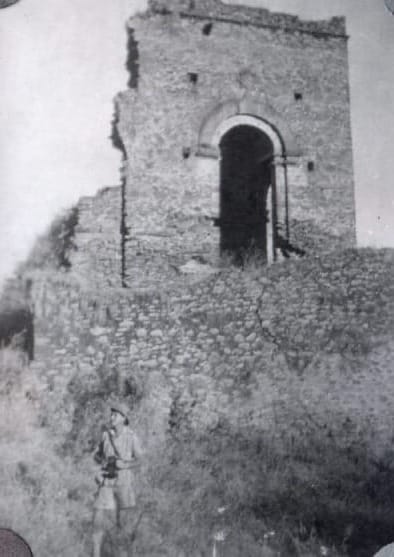
The Allies gained control of the heights overlooking Gondar and reached the town on November 23. The 26th East African Brigade (Brigadier W. A. Dimoline) was only ready below Daflecha just before midnight on 26th November. There had been much to overcome with the barbed wire and minefields. The ground presented a series of precipitous ridges impassable to vehicles, and each battalion had had to organize pack transport with 150 mules and donkeys locally commandeered. The Patriots had been impatiently hunkered down for three days and nights. At 5.30 a.m. on 27th November the guns opened on Daflecha and the 2/2nd King's African Rifles began to clamber up the steep slope to the main Italian position, the Fasil Ghebbi Fortress.
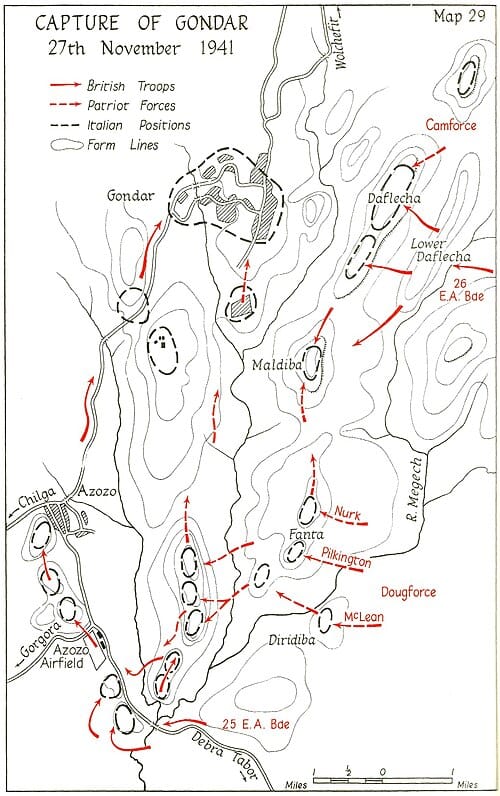
On that morning, Morris Hirsch watched from a ringside seat on one of the many ridges overlooking the town as Commonwealth armored vehicles breached the Italian barbed wire enclosure of the city. The Italian front-liners scurried in panic for safety from the accurate shelling of the Gordon Highlander's gunnery and the RAF and SAAF's aerial sorties. It filled his mind with the senselessness of war and compassion for the 'poor bastards' and what they must be feeling. Earlier that morning the Commonwealth troops had captured the nearby Azozo airfield.
The Kenya Armored Car Regiment penetrated the outskirts of the town. Nasi sent his last message to Italy, explaining that the reserve brigade had been deployed on the southern front but had been unable to stop the attack, that enemy troops had passed the barbed wire and enemy armored vehicles had entered the town. He surrendered soon after.
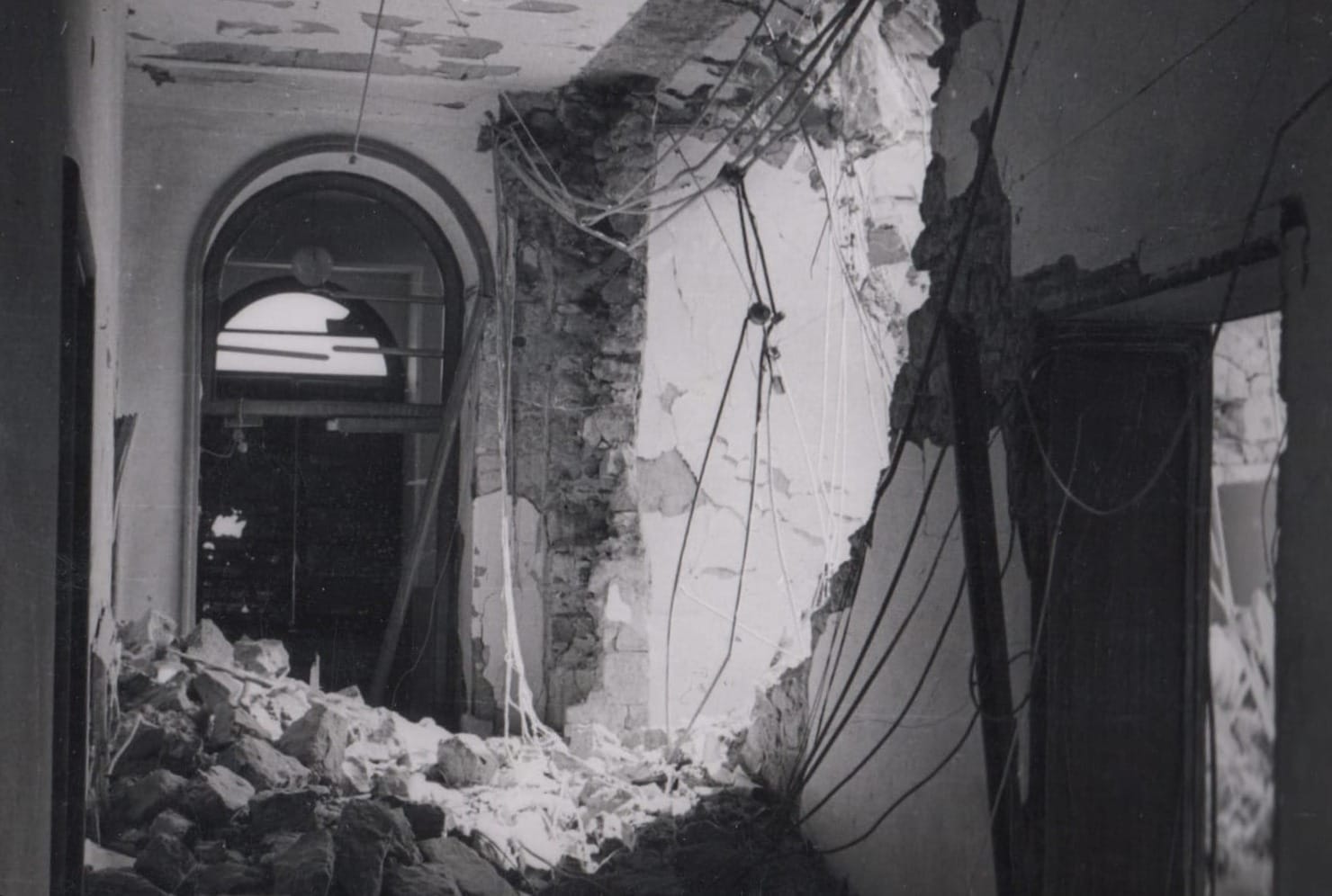
General Nasi surrendered with 10,000 Italian and 12,000 African troops. Italian casualties were 4,000 killed and 8,400 sick and wounded. British losses were 32 men killed, 182 wounded, six men missing.
Fifteen aircraft were lost from the beginning of the campaign on the 7th April.
During the final 1941 siege and assault on Gondar, the Italian and Ethiopian forces recorded 1,289 killed and 804 wounded, with 2,473 taken prisoner. Morris had work to do!

The historical novel Whitewashed Jacarandas and its sequel Full of Possibilities are both available on Amazon as paperbacks and eBooks.
These books are inspired by Diana's family's experiences in small town Southern Rhodesia after WWII.
Dr. Sunny Rubenstein and his Gentile wife, Mavourneen, along with various town characters lay bare the racial arrogance of the times, paternalistic idealism, Zionist fervor and anti-Semitism, the proper place of a wife, modernization versus hard-won ways of doing things, and treatment of endemic disease versus investment in public health. It's a roller coaster read.
References:
Excerpt from Dr. Morris Isaac Hirsch's Unpublished Memoirs. Hirsch Archives
www.ibiblio.org/hyperwar/UN/UK/UK-Med-II/UK-Med-2-16.html
Photos:
Hirsch Archives
Painting: uploaded by Fabio Saaino Public Domain
Held at Museum of Fine Arts Boston, http://www.mfa.org/collections/object/the-battle-of-gondar-1941-503016
Map: https:://en.wikipedia.org/wiki/Battle_of_Gondar